I've been putting collagen peptides in my morning coffee for a while now. Vital Proteins, unflavored, dissolves clean — you don't notice it's there.
Here's the honest version: I can't point to a specific, obvious change and say that's the collagen working. My joints feel fine. My skin looks fine. My recovery is good. But I train six days a week, sleep well, eat enough protein, and take creatine — so attributing anything specific to the collagen is genuinely difficult.
That experience is probably more common than the supplement marketing suggests. Collagen isn't creatine, where the performance effect is measurable and consistent within weeks. It's a slower, more structural compound — and understanding what it actually does, and doesn't do, changes how you think about whether it belongs in your routine.
What Collagen Is and Why It Matters
Collagen is the most abundant protein in the human body — accounting for up to 30% of total protein mass. It's the structural scaffold for virtually every connective tissue: skin, tendons, ligaments, cartilage, bone, blood vessels, and the gut lining.
There are multiple types of collagen. The ones that matter most for our purposes:
- Type I — the most abundant. Found in skin, tendons, bone. Provides tensile strength.
- Type II — primary component of articular cartilage. Relevant for joint health.
- Type III — found alongside Type I in skin and muscle. Contributes to elasticity.
The problem is that collagen production declines with age — starting gradually in your 30s and accelerating through your 40s and beyond. UV radiation, oxidative stress, poor sleep, and high sugar intake all accelerate that decline further. By the time most people start thinking seriously about joint health and skin quality, their body's collagen synthesis capacity is already meaningfully reduced from its peak.
What Happens When You Swallow It
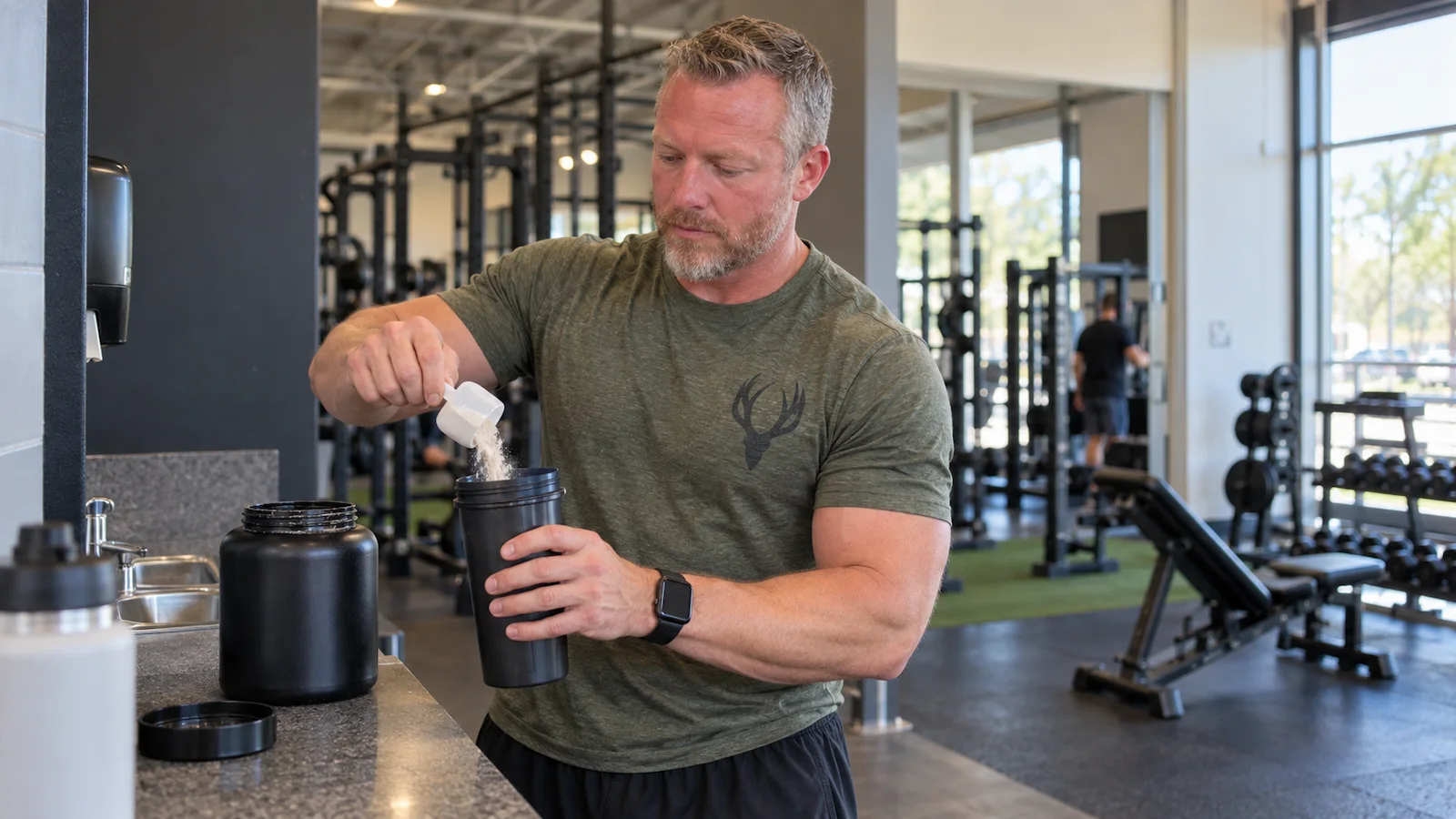
This is where a lot of people have the wrong mental model. You swallow collagen, and your body doesn't just route it directly to your joints or skin. Digestion breaks it down into amino acids and small peptides, which then enter circulation.
So how does it work?
Two mechanisms appear to be operating simultaneously:
Direct signaling. Specific collagen-derived peptides — particularly hydroxyproline-containing dipeptides — are absorbed intact and appear to signal fibroblasts to upregulate collagen gene expression. They're essentially telling the cells that produce collagen to make more of it. Raw material supply. Collagen is uniquely rich in glycine, proline, and hydroxyproline — amino acids that are essential building blocks for connective tissue but are relatively scarce in most dietary protein sources. Even if you're hitting your total daily protein target, you may be under-supplying these specific structural amino acids.Hydrolyzed collagen peptides — which is what Vital Proteins and most quality supplements use — have a meaningful advantage here. The hydrolysis process breaks the protein into smaller peptide chains that are more readily absorbed and more bioavailable than intact collagen or gelatin.
What the Research Actually Shows
A review published in March 2026, drawing on 16 systematic reviews covering nearly 8,000 participants, described the overall picture as "cautiously positive." That's a measured conclusion worth unpacking.
Joints and cartilage: The evidence here is the strongest. Multiple randomized controlled trials show collagen supplementation reduces pain and improves function in people with osteoarthritis. A 2024 double-blind placebo-controlled study found significant improvements in osteoarthritis-related pain and physical function with Type I and Type III collagen peptides. A 2025 systematic review of athletes found collagen peptides significantly enhanced joint stability, reduced pain, and accelerated recovery from injuries including Achilles tendinopathy.For active people dealing with chronic joint discomfort — the kind that accumulates from years of training — this is meaningful. It's not a painkiller effect. It's a structural one, and it takes time.
Skin: Evidence indicates that hydrolyzed collagen improves skin elasticity, hydration, and wrinkle reduction by stimulating fibroblast activity. This is one of the more consistently supported findings across the literature. Most studies showing skin benefits use 2.5–10 grams daily over 8–12 weeks. The effect is real but moderate — and again, slow to become visible. Muscle: Research on 12 weeks of resistance training combined with collagen peptide supplementation showed effects on the skeletal muscle proteome in recreationally active men. The muscle evidence is the weakest of the three categories. Collagen is not an effective muscle-building protein on its own — it lacks the amino acid profile needed to drive meaningful muscle protein synthesis. More on that below. Tendons and connective tissue: This is where some of the most interesting emerging research sits. Emerging research suggests consuming collagen with vitamin C approximately 30–60 minutes before tendon-loading activity may enhance collagen synthesis during rehabilitation. The mechanism makes sense — you're providing the raw materials and the signaling peptides right before the mechanical stimulus that drives connective tissue remodeling.The Incomplete Protein Problem
Here's something Vital Proteins acknowledges directly on their own website: collagen is not a complete protein.
Collagen is an incomplete protein because it is missing the essential amino acid tryptophan and also has low levels of other essential amino acids. About 47% of collagen is comprised of glycine, proline, and hydroxyproline, and only about 14% of collagen is made up of essential amino acids.
This matters because muscle protein synthesis — the process that drives muscle growth and repair — requires all nine essential amino acids, particularly leucine. Collagen is low in leucine. It cannot substitute for your primary protein sources when it comes to building and maintaining muscle.
The right mental model: collagen is a specialized supplement for connective tissue, not a general protein source. Its incomplete amino acid profile isn't a flaw — it's a feature of what it actually is. You wouldn't criticize a hammer for not being a screwdriver.
How to Pair Collagen for a Complete Amino Acid Profile

Since collagen is missing tryptophan and is low in several other essential amino acids, pairing it with complementary protein sources fills those gaps. Here's how to think about it practically:
The simplest pairings:- Collagen + eggs — Eggs are a complete protein with excellent leucine and tryptophan content. This is the most natural pairing for a morning routine. Two or three eggs alongside your collagen coffee covers the essential amino acid gaps completely.
- Collagen + Greek yogurt or cottage cheese — Both are complete proteins rich in leucine and tryptophan. An easy combination if you're having a breakfast bowl.
- Collagen + whey protein — Whey is arguably the most complementary pairing specifically for training. Whey drives muscle protein synthesis via its leucine content; collagen supplies the connective tissue building blocks. Together they cover both bases. Some people blend both in a single post-workout shake.
- Collagen + milk — Milk contains all nine essential amino acids including tryptophan. Mixing collagen into hot milk rather than coffee is a simple combination.
This is where most people leave performance on the table.
Collagen production is not limited only by amino acids. It is often limited by enzymatic activity, specifically hydroxylation. Even with adequate glycine and proline, synthesis can stall if vitamin C status is insufficient.
For newly synthesized collagen chains to become functional, specific proline and lysine residues must be hydroxylated by the enzymes prolyl hydroxylase and lysyl hydroxylase. These enzymes require ascorbic acid. Think of amino acids as the bricks and vitamin C as the mortar — without it, the structure doesn't set.
Practical approach: take your collagen with a vitamin C source. Orange juice, a handful of berries, bell pepper, kiwi, or a 50–100mg vitamin C supplement alongside your collagen serving. There is no evidence that timing vitamin C relative to collagen intake significantly affects hydroxylation, as the enzymatic process occurs intracellularly over hours, not minutes. But consistent co-ingestion is worth building into the habit.
A practical morning setup:- 10g collagen peptides in coffee or hot water
- 2–3 eggs or Greek yogurt alongside
- A piece of fruit or small glass of orange juice for vitamin C
- This covers the essential amino acid gaps, the cofactor requirement, and pairs naturally with how most people already start their day
Dosing and Timing
Most research showing benefits uses 10–15 grams per day. The standard Vital Proteins serving is 20 grams — that's on the higher end but well within the range studied. There's no strong evidence that more than 15 grams provides meaningfully greater benefit for most people.
Timing considerations:- For general connective tissue support and skin: timing is largely irrelevant. Take it consistently at whatever time you'll actually remember to take it.
- For joint and tendon support around training: some research suggests taking collagen 30–60 minutes before training may enhance connective tissue remodeling by supplying raw materials ahead of the mechanical stimulus.
- Morning is the most practical for most people — it pairs naturally with coffee, breakfast protein is easy to add alongside, and it becomes a low-friction habit.
Who Should Consider It and Who Can Probably Skip It
Worth considering if:- You're over 35 and training regularly — connective tissue recovery slows with age and collagen production naturally declines
- You have chronic joint discomfort that hasn't resolved with the basics
- You're recovering from a tendon or ligament injury — the evidence for connective tissue repair is the strongest in the literature
- You're already hitting your protein targets and looking for complementary support
- You're under 30 with no joint issues — the baseline need is lower and dietary collagen from whole food sources (bone broth, skin-on fish, chicken thighs) is likely adequate
- You're not hitting your basic protein targets — fix that first. Collagen won't fill a fundamental protein gap effectively.
- Budget is a constraint — creatine, protein, and magnesium have stronger performance evidence per dollar spent
My Honest Assessment
I keep taking it. Not because I can point to a specific change and say that's the collagen — but because the mechanism is sound, the research is moving in a consistent direction, the downside risk is essentially zero, and the practical cost is low.
What I've stopped expecting is a dramatic or fast noticeable effect. That's not what collagen does. It works at the structural level — maintaining and supporting connective tissue that degrades slowly over time. The absence of a problem isn't as visible as the solution to one. But for someone training six days a week in their mid-40s, keeping connective tissue healthy over the long arc of years is exactly the kind of quiet win worth pursuing.
The fundamentals still come first: total protein, sleep, progressive training, creatine. Collagen is a reasonable addition on top of those — not a replacement for any of them.
Take it with vitamin C. Pair it with a complete protein source. Be consistent. Give it at least 8–12 weeks before evaluating anything.
Want help building a supplement stack that's actually worth the money? Let's talk._