When I tell people I train six days a week, the reaction is usually some version of the same thing: that sounds like too much, that I must be overtrained, that I'll burn out eventually.
I've been doing it for years. I'm not burned out. I'm not overtrained. And I'm still making progress.
But I want to be clear about something upfront: the way I train six days a week looks nothing like what most people picture when they hear that number. It's not six days of going as hard as possible. It's not six days of the same intensity. It's a structured approach that builds in variation, manages fatigue deliberately, and treats recovery as part of the program — not an afterthought.
Here's exactly how it works.
Why Six Days Works — When It's Structured Right
The case for higher training frequency isn't complicated. Muscle protein synthesis — the process by which your body builds new muscle — is elevated for roughly 24–48 hours after a training session, then returns to baseline.
If you're training a muscle group once a week, you're getting one synthesis spike per week per muscle. Twice a week gives you two. The research on training frequency consistently shows that hitting each muscle group two to three times per week produces superior hypertrophy outcomes compared to once-a-week training, assuming volume is managed appropriately.
Six days gives me the opportunity to hit every major muscle group multiple times across the week without cramming excessive volume into any single session. Sessions stay focused, manageable, and recoverable.
The key phrase: recoverable. High frequency only works when each session is sized appropriately for recovery. Six hard sessions is a path to breakdown. Six well-structured sessions is a path to consistent progress.
The Split
My current split is a push-pull-legs structure run twice across six days, with one rest day:
- Day 1 — Push: Chest, shoulders, triceps
- Day 2 — Pull: Back, biceps, rear delts
- Day 3 — Legs: Quads, hamstrings, glutes, calves
- Day 4 — Push: Chest, shoulders, triceps (second frequency hit)
- Day 5 — Pull: Back, biceps, rear delts (second frequency hit)
- Day 6 — Legs: Quads, hamstrings, glutes, calves (second frequency hit)
- Day 7 — Rest
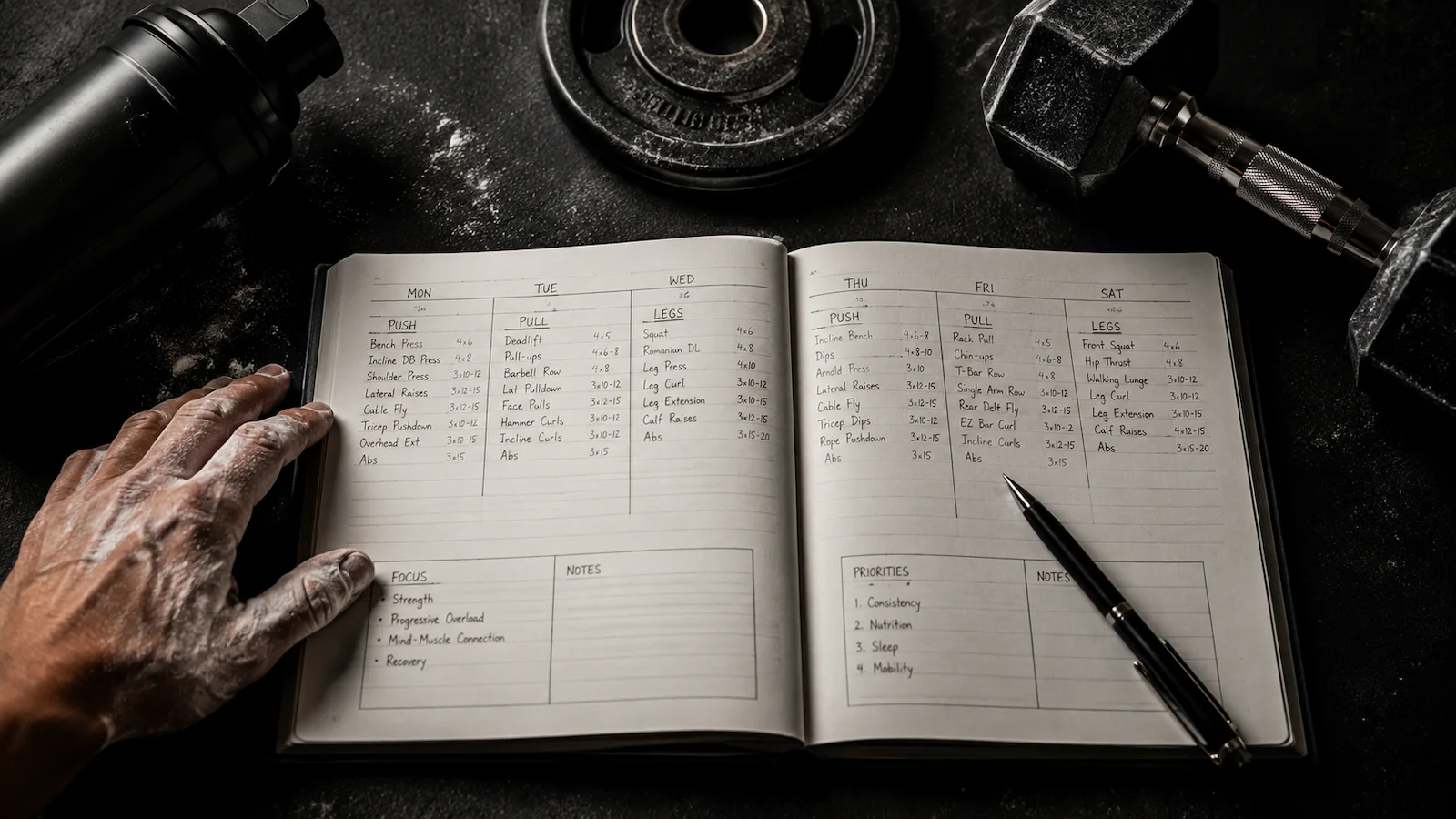
This isn't the only way to structure six days. Upper-lower splits run three times work equally well. Full-body six days a week is effective for some people. The PPL structure works for me because it keeps sessions focused on movement patterns, gives each muscle group 48–72 hours before it's hit again, and is easy to manage in terms of session length.
Each session runs 60–75 minutes. Not two hours. Not 45 minutes of actual work buried in an hour of talking and scrolling. Focused, efficient, done.
How Intensity Is Managed Across the Week
This is where most people go wrong when they try to train at high frequency: they treat every session as a maximum effort day.
That's not sustainable and it's not necessary.
My approach is to vary intensity across the two weekly instances of each muscle group:
First hit (Days 1–3): Higher intensity. Heavier loads, closer to failure on working sets, more compound movement focus. This is where I'm pushing for progressive overload. Second hit (Days 4–6): Moderate intensity. Slightly lighter loads, more volume at moderate effort, more isolation work. This session accumulates volume without adding maximum fatigue.The result is that I'm getting two quality stimuli per muscle group per week — one that pushes the edge, one that adds volume — without the recovery cost of going to the limit twice.
Volume Per Session

I keep working sets per session between 12 and 18 sets total, depending on the day. Push days at full intensity might run 16–18 sets. The second push day of the week might be 12–14 sets at moderate effort.
Total weekly volume per muscle group lands in the range research supports for hypertrophy — roughly 10–20 working sets per muscle per week, depending on training age and recovery capacity.
I'm not counting sets obsessively in the gym. But I've tracked enough over the years to know roughly where I am, and that calibration matters. Volume is the primary driver of hypertrophy. More isn't always better — but too little is a common reason progress stalls.
What Makes It Sustainable
The six-day schedule only holds up because of what surrounds it:
Sleep. Seven to nine hours, non-negotiable. This is the single biggest recovery variable I have. When sleep slips, I feel it within two sessions. Training frequency is only sustainable when sleep is adequate. Protein. I'm hitting close to one gram per pound of bodyweight daily. At six days of training, the repair demand is high. The raw material has to be there. Deload weeks. Every four to six weeks I pull volume back to roughly half my normal working sets for a week. I've written about this separately — the short version is that deloading is part of training, not a break from it. Without planned deloads, six days a week becomes unsustainable within a few months. Zone 2 cardio. Two to three sessions per week of 30–40 minutes on the assault bike or incline treadmill. This isn't extra fatigue — at Zone 2 intensity it's recovery work that improves cardiovascular efficiency and doesn't compete with the lifting. Not treating every day like a competition. The mindset shift that made high frequency sustainable for me was letting go of the idea that every session needs to be a PR attempt or a max effort day. Some days you show up, do the work at a level that makes sense given how you feel and where you are in the week, and that's enough. Consistency over intensity — every time.What I Actually Do on a Rest Day
One day off per week. I don't do active recovery sessions, I don't add cardio, I don't find ways to sneak in extra work. I rest.
This is harder than it sounds when training is a daily habit. The pull to do something is real. But the rest day isn't wasted time — it's part of the program. The adaptation happens during recovery, not during training. One full day of genuine rest per week is part of how six days stays productive rather than accumulative.
Is Six Days Right for You?
Probably not yet — and that's not an insult.
Six days a week is appropriate for someone who has built a solid base of training consistency, understands their recovery needs, and has the schedule and lifestyle to actually support it. If you're new to consistent training, three to four days done well will outperform six days done poorly every time.
The path to six days looks something like this:
1. Build three to four days of consistent, progressive training over six to twelve months 2. Add a fifth day when recovery from four days feels consistently manageable 3. Add a sixth day only when five days is well-tolerated and progress is continuing
Rushing that progression is how you get to six days and feel wrecked within a month. Earning it through gradual progression is how you get to six days and sustain it for years.
The Real Reason It Works
I've trained at various frequencies over the years — three days, four days, five days. Six days works best for me not just because of the physiological advantages of higher frequency, but because of what it does to the habit.
When training is a daily practice, it stops being something you do and starts being something you are. There's no decision to make about whether to go. You go. The only variable is what you do when you get there.
That identity shift — from someone who works out to someone who trains — is worth more than any specific program design. It's what makes the long game sustainable.
Consistency is the goal. Six days a week, structured correctly, is how I live that out.
Want help building a training schedule that fits your life and actually produces results? Let's work together._